
Beastspawn Subfactions
Threatening to engulf the world through sheer weight of numbers are the Beastspawn whose heinous hybrid forms are a mockery of both man and beast. Tails, cloven hooves and furred hides mark them as animals, so too their horns, antlers and tusks, but their torsos, arms and hands are disturbingly humanoid.
These three sub-species of nightmare are made up of bestial breeds distinguished by the dominant animal form defining their physical and mental characteristics such as: bulls for Oxataurs, goats for Ramscourge, deer for Stagogores, boars for Swinebrood, bison for Bisotaurs etc. Breeds form packs of their own kind within a Beastspawn camp, and the larger the tribe, the greater the variety of breeds present.
Beastspawn may not be the most skilled of fighters, but what they lack in dexterity they make up for with strength, speed and ferocity! Besides an abundance of willing warriors, Beastspawn possess shamans, channelling the power of the Urghast to enhance comrades with beneficial mutations and to cripple enemies with deformities.
Gorelord
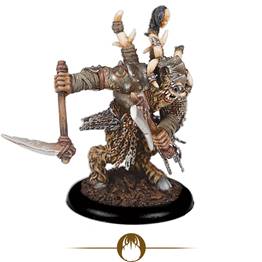 Background: Within the twisted, dank woods of Rhunetal and amid the sun-baked ruins of Minaxos a disturbing new species has been spotted. They are undoubtedly the mixed progeny of Minotaur and Fomorian, and men have taken to calling them Gorespawn. Their emergence has heralded a new age of war, for these creatures possess a size approaching that of a Minotaur, enabling many to take the reins from the dumb, brutish leaders, but they also have the cunning of a Fomorian, allowing them to organize the Beastspawn mobs into functioning horde-armies. Gorelords are known to cooperate with other races, form alliances between tribes, and even structure their minions into packs with specific roles. It is this capacity which constitutes the death-knell for humanity. These creatures are a recent development in the ever-mutating zoology of the Brood – a development which bodes ill for the future of Calydorn. Intelligence and vision are however relative terms when it comes to Banebrood, for Gorelords are extremely aggressive creatures who rule with an iron fist.
Game Role:
Primarily the Gorelord is a hard-hitting melee killer, but he also has a few tricks to boost the rest of the warband.
In terms of melee, the Gorelord is armed with 2 hand-weapons of POW5, so he can make 4 attacks per round. Add into this slay-movement and he has 6 attacks. Each time he kills an enemy he gains one action token, so when fighting a poor infantry unit with his MEL of 8, he could easily get another 2 attacks. So that’s a realistic 8 attacks when he charges militia-level troops. That tells you all you need to know about his melee potential.
On the buffing side, models and units within his Leadership range gain hardened Will, so will never break. With his Howling Mad tactic, he can give troops +1 MEL and +1 POW when they charge. This can be a massive benefit for a large unit of mediocre troops like 8 Mongrels, giving them MEL7 and POW6 with their 3 attacks each.
With a basic DEF14 and ARM7, he is not the most resilient warlord in game and can be taken down by lots of attacks from even cheap troops, but he is sure to earn more than his points value in kills when used with reasonable skill. Avoid engaging 3 or more elite enemy troops at one time, because they can really give him a bad day, but he can face off against most melee warlords and come off well.
Bisotaur Shaman
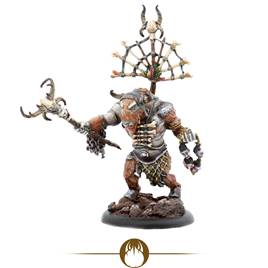 Background: On the battlefield, Bisotaurs use magic to selectively transfigure comrades, endowing them with larger muscles, heightened senses, stronger bones and exoskeletons etc. Within their dark and twisted minds lurk terrifying mutation spells yearning to be cast upon enemies, causing insides to be jellified, limbs to wither and more abominable effects. Shepherding the tribe in worship of the Urghast is part of their role, particularly conducting ceremonial sacrifices of souls to the Urghast. Channelling raw Urghast power has long-term side effects on the sanity and constitution of the shamans, and for this reason they carry devices called nightmare catchers – enchanted webs that siphon off the tainted corruption into Alchemyte crystals.
Game Role:
The Bisotaur Shaman is the spell-caster warlord of the Banebrood, but this guy is not a weakling to be kept at the back, he can get up close to the action. MEL7 is not shabby for a spell-caster, but it would be wise to get him a useful protective talisman, and don’t let him get charged by anything meaningful because DEF13 and ARM6 are not great, even when considering his 19 life points. However, he already comes equipped with a 3+ protection roll which halves all damage received, so with the Parasite Amulet or Disruption totem, he can be well protected.
Banebrood magic is primarily for buffing your own troops, as there are not a huge number of offensive spells to choose from, and all of them are de-buffing spells rather than blasting spells. However, this is not a bad thing, because the Banebrood have a huge array of awesome buffing spells to make your poor troops good and your great troops amazing.
Not only that, but the Bisotaur Shaman can upgrade mutation spells to a higher level, and can also make mutations permanent. This means you don’t need to constantly plan which spells to sustain each round – you just make them permanent for the entire game!
Pestbringer
 Background: Certain creatures which formed from the mutated spawn of the Baneplague emerged from the biological cesspool with immunity to almost every disease in existence. As the centuries passed these beasts revelled in pestilence, collecting all manner of diseases, for they represented a natural defence mechanism, keeping foes at bay. Within a few millennia some enterprising misanthropes among them began employing plagues as an offensive weapon, deliberately infecting enemies. This 10ft tall hate-filled creature possesses the bulk of a Minotaur and is covered in rotting, diseased bodily fluids. The stench of decayed flesh surrounds them, and even the mere touch of a Pestbringer can cause a tortured, agonizing death. Indeed, their prized possessions are the hosts (both living and dead) of their latest biological marvels.
Game Role:
A key aspect of the Banebrood buffing strategy is the use of Plagues. This primarily applies to Beatsspawn subfaction models who have an ability which allows them to host the plague harmlessly, and pass it on to enemy models they hit in melee. When you add plagues to buffing from mutation magic and then throw in a tactic or two, you are able to build very powerful models even from basic rubbish. This is particularly easy for the Beastspawn because spells can be made permanent, and the plagues of the Pestbringer also last for the entire game.
But why not just buy the Bubonic Fleas item for your warlord (giving him the same plague infecting ability) and then leave the Pestbringer at home?
Two reasons – firstly that uses up an important talisman option which could otherwise be spent on a protective item for your warlord. Secondly, the Pestbringer is so much more than a buffer. Firstly, he has a rather disgusting missile attack, throwing infected offal at your enemies, which can result in direct plague infection. Secondly, it is often useful to have a character around for special roles like warlord bodyguard or war-machine destroyer, or item-finder for various scenarios.
In melee he is no slouch with a POW4 weapon which ignores shields, but with MEL6 he is clearly not a front line melee character. 17 life points means he can do fine against militia troops but against an enemy elite unit model he will likely only list a round.
Fallow Shaman
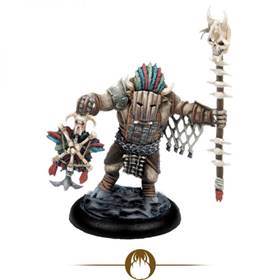 Background: Cloaked in shimmering waves of power the Fallow Shamans emerge from the wilderness, blighting fields, mutating beasts and disfiguring foes with an evil desire to twist and pervert everything they see. Fallow Shamans are the junior mage-priests who serve the tribe’s Bisotaur Shaman, and like their master, they are revered and feared by the rest of the superstitious brutes that make up the tribe. On the battlefield they use their magic to augment comrades with helpful mutations, providing them an edge in combat; or they afflict enemies with crippling ailments.
Game Role:
The Fallow Shaman is a typical spell-caster character, meaning he should be protected from enemy attacks due to his low DEF and ARM. Like the Bisotaur Shaman, the Fallow Shaman can also upgrade mutations, but he is not able to make mutations permanent. He has access to all the same spells, which are primarily buffing spells, and a few de-buffing spells.
The Fallow Shaman is a universally useful model for the Banebrood. Even a warband focussed on the Reaver subfaction would do well to take one along because Reavers also can benefit from all mutation buffing spells. Reaver Tribesmen are particularly suitable because they provide the Shaman’s spell-casting roll with a +1 for receiving mutation spells. So it’s worth reserving 30 points to take one of these useful guys (23 points plus cost of spells). In a large warband it is worth taking two Fallow Shamans.
Maldire Mongrels
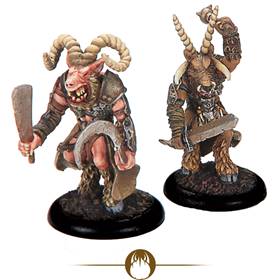 Background: Interbreeding between subspecies of Fomorians spawns hybrid degenerates known as Mongrels – creatures despised by the pure-bred Beastspawn, kept as slaves to do the menial tasks. Their fur is matted with urine, sweat, vomit, faeces and last week’s carrion. Consequently their immune systems developed a resistance to disease, making them ideal carriers of virulent plagues. As a natural part of their primitive fighting skills, Mongrels bite their foes, thereby infecting these horrific pathogens. In battle, Mongrels constitute expendable troops, thrown at the enemy in wild charges. Nevertheless they represent a considerable threat due to their speed and agility, enabling them to close rapidly with foes. When they do pile into the enemy line, they strike powerful blows with multiple weapons.
Game Role:
Mongrels are a cheap militia-level unit of melee troops. They are fast and furious but don’t last too long in protracted melees. Because they are light infantry, even with their basic stats, they can move 15 inches per round can charge 13 inches compared to the normal 8 inches of most models. That means they will almost always be charging, and benefitting from the charge bonus.
But one successful strategy with Beastspawn is “buff, buff, buff”. So Mongrels buffed by the Howling Mad tactic ordered from the warlord double their charge bonus. But likely early in the game you have already infected them with a plague, so when they hit the enemy they will cause him to be knocked down or suffer extra direct damage or some other nastiness. On top of that you will probably have buffed then with a spell or two from one of your Shamans giving them Bug-stalk eyes (EF bonus), Bulging Biceps (POW bonus), Exoskeleton (ARM bonus), or Long Legs (MOV bonus). But there are many more besides those.
With a maximum unit number of 8 models, they can really be a serious menace when buffed up. What’s more, you can take up to 4 units in a regular warband.
Alternatively, they are cheap enough to be expendable and used a speed bump or sacrifice, especially if you only take a minimum unit of 4 models. Either way, Mongrels can be used as a horde warband or perhaps as a single flanker unit to speed across the table and take out war-machines and archers. In fact being good but expendable, they have many potential uses.
Fomorian Gut-Hackers
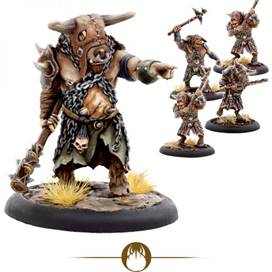 Background: Making up the bulk of the Beastspawn’s frothing hordes of horror are the Fomorians – humanoid beasts possessing a recognizable animal forebear, such as goat, bull, stag, boar or wolf. Bisonbrood Fomorians are known for their magnetic attraction of Urghast energy and their resistance to mutation. Their elite fighting packs are called Gut-Hackers – ferocious warrior-beasts armed with great war-picks. A shroud of psychic force surrounds the Gut-Hackers, which is invaluable for Shamans who draw upon it to boost their horrific mutation magic. Not surprisingly, Gut-Hackers Hackers often form shaman bodyguards. In battle Gut-Hackers don thick furs and leathers as well as the chainmail and breastplates ripped from the unworthy corpses of defeated enemies. Their favored possession is their two-handed war-pick – a weapon which can punch a fist-sized hole through bronze armor with ease once their thundering, cloven hooves have borne them across the battlefield.
Game Role:
Gut Hackers are an elite melee unit. At 21 points each they are not cheap, but they are really worth every point. With these guys you have two melee options; they have a POW7 attack and a POW4 attack. On top of that they have the tactic Circular Slash allowing each model to hit multiple enemies. Even with their basic stats, they can use the tactic and make the Circular Slash attack twice per round! This is devastating on unit models. Alternatively, assign them an action token from the warlord, then they can make a POW7 circular Slash and a POW4 circular Slash in a single round.
DEF13 and ARM7 are pretty much average for melee troops, but they also have 8 life points each, making them reasonable tough. Nevertheless, it’s best not to leave them in prolonged melees, and like most Banebrood models they are fast and furious but not long-lasting.
Add to that their ability to carry plagues, a special bonus they provide spell-casters within 4 inches, and they cause Fear. That’s a great package for their points.
On the downside, 21 points per model is a lot to lose if they get shot to death before even getting into melee…For that you need clever strategies.
Ursapine
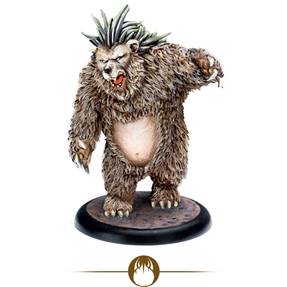 Background: During the mythical epidemic known as the Baneplague, untold numbers of bizarre and wretched abominations were spawned in pits of thrashing protoplasm. Most of these biological mishaps were sterile and died out, but to mankind’s misfortune some were able to breed, and over the centuries their genetic variation stabilized into standard forms. One of these is the Ursapine. This hulking bear-like beast is blessed with a forest of needle-sharp quills adorning its back. Running on four legs, it chases and drags down its prey, while rearing up on two legs it brutalizes foes with fangs and claws. Although Ursapines weigh 1,500 lbs (700kg), they are carved from pure muscle and can easily catch a sprinting man. In battle their primary advantage is their tremendous speed.
Game Role:
The Ursapine is a classic Godslayer creature, meaning it’s a tough, single-model with good melee stats who can pile into a unit and wreak havoc.
The Ursapine has decent melee stats but also has a tactic allowing it to curl into a ball and roll over multiple enemy models with its sharp, poisonous pines. Or use its other tactic which causes enemy models within 1 inch who damage it to suffer a damage roll themselves from a poisonous attack.
Perhaps the Ursapine’s greatest advantage is its speed. It can move 16 inches per round and charge 12 inches. Why not cast an upgraded Long Legs spell on the Ursapine and make it a light cavalry model with MOV5, meaning is can move 25 inches per round or charge 19 inches! With speed like that, it can charge enemy war-machines at the back of the board in round 2.
If you want to scare the hell out of your opponent, then why not deploy 3 of them!
Besides the obvious used, it can be a great bodyguard for your warlord (even blocking line of sight because of its large base) which can protect the warlord from missile fire. Or use him to pin units or accomplish objectives in scenarios etc.